Tuesday, February 12, 2013

car brake

Brake is a device to slow or stop the movement of the wheels. Because the wheels slowed down, it automatically slows the vehicle motion. The kinetic energy is lost from a moving object is usually converted to heat due to friction. In regenerative braking, most of this energy can be recovered and stored in rodagila (flywheel), capacitors, or converted to alternating current by an alternator, then dilalukan through a rectifier (rectifier) and stored in the battery for another use.

The kinetic energy increases by the square of the speed (E = ½ m · v2). This means that if the speed of a vehicle increases two times, it has four times as much energy. Brakes have to throw four times as much energy to stop and consequently, the distance required for braking is also four times as far.


The brake system in automotive engineering is a system that serves to:

     Reduce vehicle speed.
     Stopping the vehicle is running.
     Keeping the vehicle remains stopped.


The main components in the brake system consists of:

     Brake pedal or brake lever.
     Amplifier (booster).
     Master cylinder (master cylinder).
     Braking or cable channels (lines).

Radiator

Radiator is a part or component of the cooling system that uses water cooling system. because it is a function of the radiator to cool the engine. Radiator as we know it is mostly used in motor vehicles (two-wheel or four-wheel drive), it is not uncommon radiator is also used on machines that require refrigeration eksstra. As in the production machine or other machine that works in conditions of severe or prolonged labor. In both the motor vehicle or car radiator usually located in front and to be near the engine or in positions that are favorable for the cooling system. It aims to bring the machine to get maximum cooling machine as needed.

central engine

Middle engine is the engine position laying on the front axle and rear axle.

profit

Advantages laying machine in the middle is the uneven distribution of weight distribution. Heaviest component in the car is placed as close as possible to the center of the vehicle, thus reducing the moment of inertia of the vehicle, so the control, traction, and ride quality when turning, braking, and acceleration could be better by itself.

Laying in the middle of the machine to give an extra burden to the rear wheels, so traksinya increases. This reduces the possibility of rear tires locked up and reduce the chance of slippage adalnya. If the middle-engined cars also use a rear-wheel drive, so it can improve acceleration on slippery roads. Laying It also makes ABS brakes and traction control systems work better. This engine also adds to the safety car, because if such a crash, there is a gap between the engine and the car bumper to absorb the impact so that the possible effects of a collision up to the passenger cabin is smaller.

rear engine

Back of the machine is one of the approaches in the design of vehicles, with the engine placed at the rear of the vehicle so that the vehicle can be styled rooms with easier and more aerodynamic. Vehicles with rear engine was originally developed by Hitler to create a people's car Volkswagen named later known as the VW Beetle, in Indonesia known as the VW Beetle.

By placing the engine in the back, so the car can be designed with a low coefficient geseknya. Usually used in luxury sports cars such as Ferrari and Porsche. In addition to the car is also now widely used bus rear engine.

Advantages rear engine

> Easy on the production vehicle,
> Because of the location of the machine on wheels that propel the vehicle, the friction of the road is higher,> It is easier to plan the passenger cabin space> Radiation heat generated by the machine can be reduced with better> Cabin space is less noisy than the front engine.

Losses rear engine
> Because of the location of the engine behind could result in driving the vehicle at the corner becomes more difficult,> Can not medeteksi abnormalities that occur in the engine, especially on bus

front engine

Front engine layout engine is an order in a car that was in the front. The location of the engine is in the front is the most popular configurations. In this configuration the machine is placed in front of the passenger cabin.

Advantages:
> More secure (the machine can be a shield from impact from the front)> More easily cooled (as it directly receives the flow of the wind)> Easier to maintain (because of its position at the front, it is always visible to the driver and passenger)

disadvantages:
> The weight of the car leaning forward> For rear-wheel drive will be a lot of wasted energy> Limiting aerodynamics

Engine in front of cause most of the weight concentrated in the front of the vehicle. This is usually overcome by trying to divide the weight of the vehicle gets belakang.Seperti distribute engine power to the rear wheels, it automatically makes weight more evenly, because the drive wheels and transmission device that is placed in the middle to balance the weight of the engine in front. But this way has a number of disadvantages that the engine power is wasted in the way of the engine in the front towards the rear tire on, slowly configuration front engine rear-drive being replaced front engine - driving forward. Configuring a front engine rear-drive is still popular for transport vehicles.

Configure the front-engine front-wheel drive is very exciting to be produced by the engine, transmission, steering in a single package, thus:

> cheap
> easy> light> efficient

losses that arise are uneven load distribution, it is compensated by designing a more advanced electronics and tools that can make the car more stable.

supercharger

Supercharger (also known as a blower) is a gas compressor used to pump air into the cylinder combustion engine. Mass additional oxygen is forced into the cylinder making machines burn more fuel, and increasing the engine's volumetric efficiency and make it more powerful. A supercharger is powered mechanically by the rope-or chain-puller of the engine crankshaft.

Similar supercharger with a turbocharger, but the turbocharger is powered by the flow of gases that drive the turbine engine. Supercharger can absorb as much as a third of crankshaft engine power in most applications and are less efficient than turbochargers. In applications where power is more important than other considerations, such as top fuel dragster and vehicles used in tractor pull competition, the supercharger is very common.

turbocharger

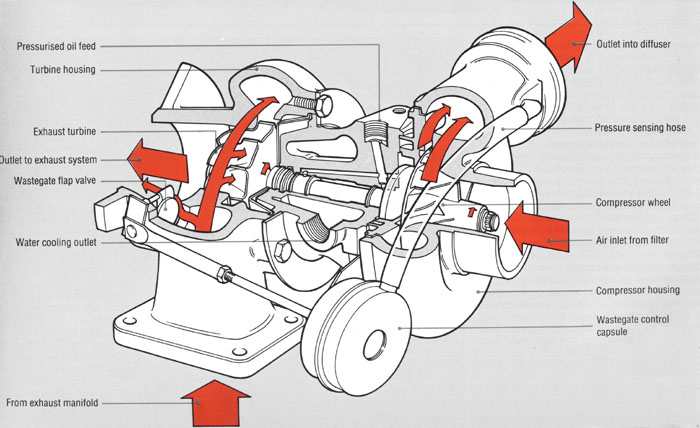
The turbocharger is a centrifugal compressor that gets power from the turbine energy source comes from vehicle exhaust fumes. Commonly used in internal-combustion engines to increase power output and efficiency of the engine by increasing the pressure of air entering the engine. The key advantage of turbochargers is that they offer a lot of good improvements in engine power with little added weight.

Turbocharger discovered by a Swiss engineer Alfred Buchi. Applied for its patent for a turbocharger used in 1905. Locomotive and vessel diesel with turbocharger machined was also seen in the 1920s.

A loss in a gasoline engine is the compression ratio should be lowered (so as not passed through the maximum compression pressure and to prevent engine knocking) that decrease the efficiency of the machine when operating at low energy. This loss was not on the diesel engine designed specifically diturbocharge. However, for operation at altitude, energy income from a turbocharger make much difference to the total energy output from the second type of machine. This last factor makes aircraft engines with turbochargers is very profitable, and is the beginning of thought to the development of this tool.